Stop Saying 'I'm Sorry': Nicole Sodoma on Reclaiming Power After Divorce
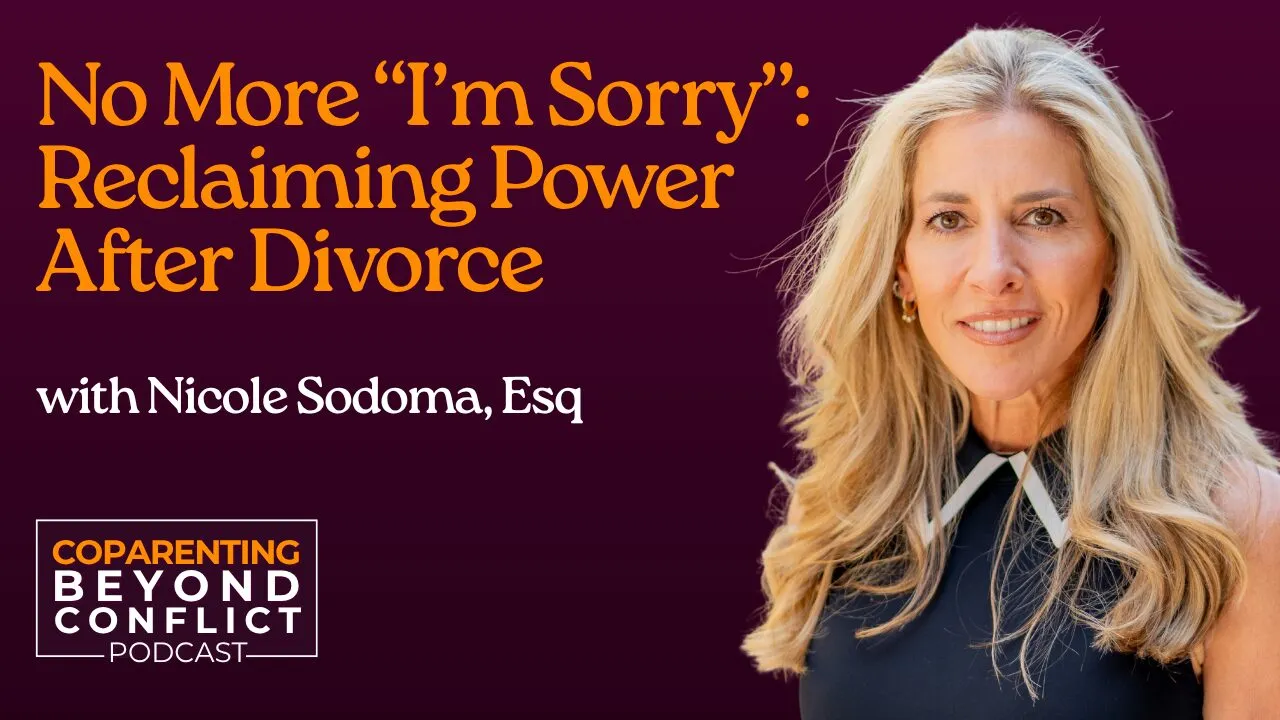
If you have ever announced your separation only to be met with a chorus of “I’m so sorry,” you already know how hollow those words can feel. Research consistently shows that the language we use around divorce shapes how we experience it — and when everyone around you responds to your news like it’s a funeral, it is nearly impossible to feel empowered. That is exactly where family law attorney and author Nicole Sodoma picks up the conversation in Episode 11 of the Coparenting Beyond Conflict podcast, and it is a conversation I did not want to end.
Nicole is the founder of one of the largest family law firms in the country, the author of Please Don’t Say You’re Sorry, and — critically — a divorced mother of three who has navigated the exact trenches her clients are sitting in. When I sat down with Nicole Sodoma, what struck me immediately was her refusal to let anyone stay small inside a story that does not serve them. If you are exhausted by the conflict and wondering if any of this ever gets easier, this episode is for you.
Watch the episode and clips
Nicole Sodoma and the Problem with “I’m Sorry”
The title of Nicole’s book is not just provocative — it is a blueprint. When she announced her own separation after nearly two decades as a divorce lawyer, she was floored by how often people reached for those two words. And every time someone said it, something inside her deflated.
“You stop feeling empowered,” she told me. “You start feeling victim. You start feeling sad for yourself, sad for your children. And it doesn’t have to be the perspective.”
She connected the instinct to apologize to a broader cultural habit — particularly among women — of using “I’m sorry” as a reflexive social lubricant rather than a genuine expression of feeling. When someone says “I’m sorry” to you after a divorce, they are often borrowing the language of condolence. They are treating your new chapter like a death. But it does not have to be.
The reframe Nicole offers is simple and powerful: you get to choose your perspective. The circumstances of your separation — whether you chose it or it was chosen for you — do not have to define how you show up going forward. This kind of mindset shift is the foundation for everything else she talks about, from communication strategies to courtroom credibility.
If you find yourself stuck in the apology loop — either hearing sorry too often or reflexively saying it yourself — you might also find value in exploring why your difficult ex might actually be your best post-traumatic growth personal trainer. Reframing is not denial. It is strategy.
Nesting, Conscious Uncoupling, and the Reality Check Co-Parents Need
One of my favorite parts of talking with Nicole Sodoma was her willingness to puncture some of the more romanticized ideas floating around the divorce space right now. Two in particular came up: nesting and conscious uncoupling.
Nesting: Great in Theory, Complicated in Practice
Nesting — where the children stay in the family home and the parents rotate in and out — is often presented as the gold standard for minimizing disruption to kids. And in low-conflict situations, it can work. But Nicole was direct: in high-conflict relationships, nesting is rarely sustainable.
“There’s lots of invasion of privacy feelings. It’s intrusive. There’s no peace for the parents, and there’s certainly no empowerment,” she said.
She also raised a practical point that often gets glossed over: your readiness (or one partner’s readiness) to start dating. In many states, you can legally begin a new relationship the day you separate. Nesting while one or both parents is ready to move on introduces a layer of complexity that can quickly destabilize the arrangement — and the children who depend on it.
The guilt many high-conflict co-parents feel for not being able to “make nesting work” is real, but Nicole’s perspective offers genuine relief: sometimes saying no to nesting is the most child-centered decision you can make.
Conscious Uncoupling: It Takes Two
Nicole was equally measured about conscious uncoupling. She loves the ideal — keeping children at the forefront, resolving things collaboratively — but reminded me of something essential: “It takes two to say I do and one to say I don’t.”
If your ex is not approaching the process in good faith, no amount of your own intentionality will make it truly collaborative. That does not mean you stop trying to be your best self. It means you stop punishing yourself for a dynamic that was never fully in your control. For a deeper dive into this tension, the conversation I had with Joe Dillon on protecting your children in divorce is worth revisiting.
Parallel Parenting After Divorce: A Path, Not a Destination
I asked Nicole directly about parallel parenting and whether she thinks it works for high-conflict families. Her answer was characteristically nuanced.
“I think it’s a path,” she said. “You’re going to be not necessarily working together, but you’re working and going in the same direction. Like, we’re going to be on the same highway going in the same direction. We might not even have the same goals, but the communication is going to feel different.”
What she is describing is the heart of what makes parallel parenting functional for so many high-conflict families: it does not require trust or warmth. It requires structure. And when the structure breaks down — when there’s a genuine impasse — you need a predetermined resolution path. That might be mediation. That might be a neutral third party. But you need it built in before you need it.
For families navigating this dynamic, having a reliable communication channel is not optional — it is foundational. That is exactly why I built the BestInterest Solo Mode. Even if your co-parent refuses to use the app, you can still use it on your end to filter incoming messages, protect your emotional bandwidth, and document everything. You do not need your ex’s cooperation to protect your own peace.
5 Communication Strategies Nicole Sodoma Recommends for High-Conflict Co-Parents
Communication was the drumbeat running underneath almost everything Nicole and I discussed. She kept coming back to it because, as she put it, knowing how to best communicate with the other parent is the most underrated tool a divorced parent has. Here are five specific strategies she laid out:
- Structured weekly emails. Nicole advises clients to send one to two emails per week organized by category: social, academic, medical, other, and upcoming dates. This keeps communication purposeful and eliminates the spiral of back-and-forth texts.
- Use the space between stimulus and response. She referenced a concept she calls “the space between” — the moment between receiving a triggering message and choosing how to respond. In that space, you have freedom. A breath, a pause, even just writing the email without sending it can be the difference between escalation and resolution.
- Match your communication method to your conflict level. Not every situation warrants a real-time phone call. Nicole encouraged intentional choices about the medium: a dedicated co-parenting app, structured emails, or a shared calendar for scheduling, depending on how contentious the relationship is.
- Learn how your ex actually receives information. Nicole referenced Dr. Bill Eddy’s work on communicating with high-conflict personalities, noting that telling a narcissist they are a narcissist will never produce the result you want. You have to understand how the other person processes information and adjust your approach accordingly. The BIFF Method is a great starting point for this.
- Pick your battles intentionally. At the start of any custody case or major co-parenting conflict, Nicole tells clients to make a list of their real priorities. Then, protect those fiercely and let the rest go. What is genuinely worth the financial, emotional, and relational cost of a fight? That question will answer itself if you are honest.
The BestInterest Tone Guardian was built precisely for the space Nicole describes between stimulus and response. Before you send a message that might escalate the conflict, Tone Guardian analyzes your language and flags anything that could land the wrong way — giving you back that critical pause before your words become evidence.
What Nicole Sodoma Says About Family Court Credibility
Nicole dropped one of the most sobering truths about family court that I have heard on this podcast: “The biggest lie parents are sold about family court is that it will feel like a win.”
You might win on one issue. The judge might have a bad day. They might have been a criminal judge before family law. They might be charmed by a high-conflict ex who performs beautifully in the courtroom. So much is outside your control.
What is inside your control? Your credibility. And Nicole made it clear that credibility is fragile. She shared a story about a father who, while still on the phone with his children’s mother, began speaking viciously about her to one of the children — not knowing she was still listening. She recorded it. He lost credibility instantly and irrevocably in that case.
The lesson is not just about what you say in court. It is about every text, every voicemail, every email you send from this day forward. Judges form impressions. Documentation tells stories. If you are in a high-conflict situation, building a consistent, verifiable record of your own reasonable behavior matters enormously.
The BestInterest Coparenting Journal and Verified Reports exist for exactly this reason. Every journal entry you make is timestamped and verifiable. When your attorney asks for documentation, you will have it ready — organized, credible, and clear.
For more on navigating the family court system with strategy rather than emotion, the conversation I had with attorney Kirk Stange goes deep on the tactical side of high-conflict cases.
Nicole Sodoma’s Parting Words for the Parent Who Is Feeling Defeated
I closed our conversation by asking Nicole to speak directly to the parent who is listening right now and feeling completely overwhelmed. Her answer was generous and grounded.
“Recognizing that the roller coaster of freedom and grief will last minutes. Maybe it will last a day. But it will continue to be freedom and grief until they’re settled. And they have to have faith in that. And also, allow yourself a day off from whatever chaos you’re feeling. Getting separated and divorced can feel like a full-time job. Showing yourself some grace and taking a full day off from all the chaos will help.”
That combination — faith in the process and grace for yourself — is the foundation of everything else. You cannot communicate strategically, protect your credibility, or parent from your best self if you are running on empty. If you are hitting that wall right now, the piece I wrote on creating your anchor list when coparenting burnout hits might be exactly what you need today.
Listen to My Full Conversation with Nicole Sodoma
Everything I have shared here only scratches the surface of what Nicole brought to this conversation. Her personal experience as a divorced parent — layered on top of nearly two decades of family law practice — gives her a perspective that is both legally grounded and genuinely human.
You can listen to the full episode of Coparenting Beyond Conflict with Nicole Sodoma wherever you get your podcasts, or stream it directly at the link below. If this episode resonated with you, I would be deeply grateful if you shared it with someone who needs to hear it today.